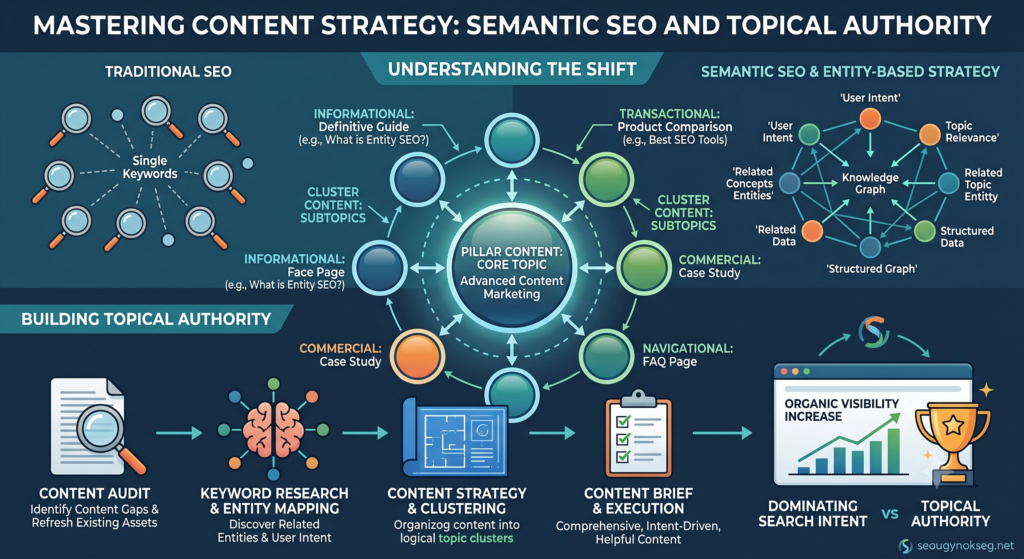
The landscape of search has fundamentally shifted. For years, digital marketers relied on a linear, isolated approach to ranking: find a high-volume query, sprinkle it throughout an article, build a few backlinks, and watch the traffic roll in. Today, that approach is not just outdated—it is actively detrimental to your organic growth.
Welcome to the advanced guide from seougynokseg.net. In this comprehensive deep dive, we will explore how elite marketing teams are abandoning basic keyword stuffing in favor of semantic SEO and entity-based architectures. By shifting to a topic-led mindset, you can build an authoritative web presence that dominates search engine results pages (SERPs) and genuinely serves your users.
The Evolution of Search: From Strings to Things
To master modern content SEO, you must first understand how search engines process information. Google’s algorithmic leaps—from Hummingbird to RankBrain, BERT, and MUM—have transitioned the search engine from a lexical engine (matching text strings) to a semantic engine (understanding real-world concepts).
“Search engines no longer rank documents based on the repetition of characters; they rank them based on their understanding of the relationships between entities.”
What is Semantic SEO?
Semantic SEO is the practice of building content around topics rather than individual keywords. It focuses on the meaning behind the search query and the relationships between different concepts within a specific niche. This requires a transition from basic keyword research to comprehensive entity analysis.
What is Entity SEO?
An “entity” is a distinct, well-defined concept or thing—a person, place, idea, brand, or abstract concept. Entity SEO involves optimizing your content to help search engine algorithms recognize these specific entities and the context connecting them. Instead of merely trying to target the phrase “best running shoes,” an entity-based approach connects “running shoes” to related entities like “pronation,” “EVA foam,” “trail running,” and “marathon training.”
By adopting an entity-based mindset, your content strategy aligns perfectly with Google’s Knowledge Graph, drastically increasing your chances of capturing rich snippets, AI Overviews, and top-tier rankings.
Conducting an Intent-Driven Content Audit
Before you can build a new empire, you must survey the land you already own. An intent-driven content audit is the crucial first step in pivoting your strategy. Many marketing teams churn out net-new content without realizing their existing pages are bleeding topical relevance.
Identifying Gaps and Decay
A successful content audit evaluates your current URLs against the modern standards of search intent. You need to ask: Does this page comprehensively answer the user’s implicit and explicit questions? Or is it a thin, keyword-stuffed relic of 2015?
- Inventory Your Assets: Pull all indexable URLs using a crawler (like Screaming Frog) and combine them with Google Search Console data.
- Evaluate Search Intent: Map each URL to a specific stage of the buyer’s journey (Informational, Navigational, Commercial, Transactional).
- Analyze Entity Coverage: Run your top-performing pages through an NLP (Natural Language Processing) tool to see which entities Google associates with your content. Are you missing critical subtopics?
- Execute the Refresh: Don’t just build new pages. You must refresh decaying content by injecting missing entities, updating outdated statistics, and improving the depth of the information.
Content Audit Action Matrix
Use the following framework to decide the fate of your existing pages:
| Audit Action | Criteria | Strategic Goal |
| Keep | High traffic, perfectly matches search intent, comprehensive entity coverage. | Maintain rankings; build internal links from this page to new clusters. |
| Refresh | Good backlinks, decaying traffic, poor semantic depth. | Update with modern semantic SEO practices; add missing entities. |
| Merge | Multiple pages cannibalizing the same keyword/intent. | Consolidate link equity into one definitive, topic-led master guide. |
| Delete | Zero traffic, zero links, completely irrelevant to your core entities. | Remove dead weight to optimize crawl budget and site-wide quality signals. |
Architecting a Content Strategy for Topical Authority
Once your existing assets are optimized, it is time to build out your future content strategy. The goal is no longer to rank for a single golden keyword; the goal is to achieve topical authority.
Topical authority is a measure of depth. It is the search engine’s confidence that your website is the definitive expert on a specific subject. You earn this trust by exhaustively covering a core topic and all its related subtopics through a highly organized topic cluster.
The Topic Cluster Model
A topic cluster is an SEO architecture that organizes your site’s content into neat, interrelated silos.
- The Pillar Page: A comprehensive, broad overview of your core topic (e.g., “The Ultimate Guide to Content Marketing”). It touches on every subtopic but leaves room for deep dives.
- The Cluster Pages: In-depth articles focusing on specific, long-tail subtopics (e.g., “How to Build a Content Marketing Team,” “Content Marketing Metrics to Track”).
- Internal Linking: The “glue” that holds the cluster together. Every cluster page links back to the pillar page, and the pillar page links out to every cluster page using descriptive, entity-rich anchor text.
How to Map and Cluster Entities
To transition to content-led growth, your team must meticulously research and map the ecosystem of your niche.
- Identify the Core Entity: What is the fundamental concept your business owns? (e.g., “Email Marketing”).
- Extract Related Entities: Use tools like Google Suggest, Wikipedia, or advanced SEO software to find nodes connected to your core entity (e.g., “deliverability,” “segmentation,” “subject lines,” “A/B testing”).
- Cluster by Intent: Group these entities into logical subtopics. Ensure you cluster them based on what the user is actually trying to achieve, rather than just loose lexical similarity.
Engineering the Perfect Content Brief
Even the most brilliant content strategy will fail if the execution is poor. The bridge between strategic planning and writer execution is the content brief. In the era of semantic SEO, a brief can no longer be just a title and a target word count. It must be an architectural blueprint.
A highly effective content brief ensures that the final output is helpful, relevant, comprehensive, and perfectly calibrated to user intent.
Essential Elements of a Semantic Content Brief
- Primary Entity and Search Intent: Clearly define what the page is about and why the user is searching for it. Is the user looking for a tutorial, a definition, or a product comparison?
- Target Audience & Pain Points: Who is reading this? What specific problems does this content need to solve?
- Entity Checklist: Provide the writer with a list of related entities and concepts that must be naturally integrated into the text. (e.g., If writing about “SEO,” the brief must require mentions of “crawlability,” “indexing,” “backlinks,” and “search algorithms.”)
- Structural Outline (H2/H3): Dictate the information hierarchy. Ensure the headings themselves contain relevant entities and answer the questions Google’s NLP expects to see.
- Internal Linking Map: Specify exactly which existing cluster pages this new article should link to, and which existing pages will be updated to link to this new asset.
By utilizing a rigorous brief, you ensure that every piece of content published contributes to your overall topical authority rather than existing in a vacuum.
Step-by-Step FAQ: Building a Topic Cluster from Scratch
To make this advanced theory actionable, let’s break down the actual process of building a topic cluster from the ground up.
Q1: How do I choose a core topic for my pillar page?
Answer: Your core topic should be a broad, high-level concept directly tied to your product or service. It should be substantial enough to warrant 10 to 30 supporting subtopic articles. Look at your business’s core value proposition. If you sell CRM software, your core topics might be “Sales Pipelines,” “Customer Retention,” and “Lead Generation.” Ensure the topic has sufficient search volume but is broad enough that no single article could answer every possible question about it.
Q2: How do I map subtopics to the pillar?
Answer: Start by looking at the SERPs for your core topic. Check the “People Also Ask” (PAA) boxes and “Related Searches” at the bottom of the page. Next, use semantic research tools to extract the entities associated with your core topic.
Create a mind map. If your pillar is “Lead Generation,” your subtopics (cluster pages) will naturally break down into:
- B2B Lead Generation Strategies
- Lead Magnet Ideas
- Cold Email Templates
- Inbound vs. Outbound Lead Gen
Every subtopic must have its own distinct search intent, ensuring your pages do not cannibalize each other.
Q3: How do I target the right entities within my cluster pages?
Answer: Instead of looking for traditional LSI keywords (a largely outdated concept), look for nodes in the Knowledge Graph. Use Wikipedia pages related to your topic and note the hyperlinked concepts within the text—these are recognized entities. Additionally, run the top 3 ranking competitors for your subtopic through an entity extraction API (like Google’s Natural Language API demo). You will see exactly which entities Google is prioritizing for that specific intent. Mandate these entities in your content brief.
Q4: How should I structure internal links within the cluster?
Answer: Internal linking is the most critical mechanical step in establishing topical authority.
- The Pillar Link: Every single subtopic page must link back to the main pillar page. Use consistent, exact-match or highly relevant anchor text (e.g., linking back via the anchor “lead generation strategies”).
- Cross-linking: Subtopic pages should link to each other when contextually relevant. If your article on “Lead Magnets” mentions “Cold Emailing,” hyperlink to your “Cold Email Templates” cluster page.
- Orphan Pages: Absolutely no page in your cluster should be an “orphan” (a page with zero internal links pointing to it).
Q5: How long does it take to establish topical authority?
Answer: Building authority is not an overnight process. Depending on the competitiveness of your niche and the current authority of your domain, it can take anywhere from 3 to 6 months after a full cluster is published and indexed to see the “authority multiplier” effect. The key is to publish the cluster comprehensively and ensure every single piece of content is genuinely helpful and deeply researched.
Conclusion
Mastering modern content marketing requires a fundamental shift in perspective. By moving away from hyper-fixated, isolated keyword metrics and embracing semantic SEO, you future-proof your website against algorithmic volatility.
By conducting rigorous audits, structuring your site with interconnected topic clusters, and enforcing strict, entity-focused content briefs, you transform your website from a collection of random articles into an undeniable source of topical authority. Commit to this intent-driven approach, and you will capture the organic visibility that only elite, content-led brands achieve.