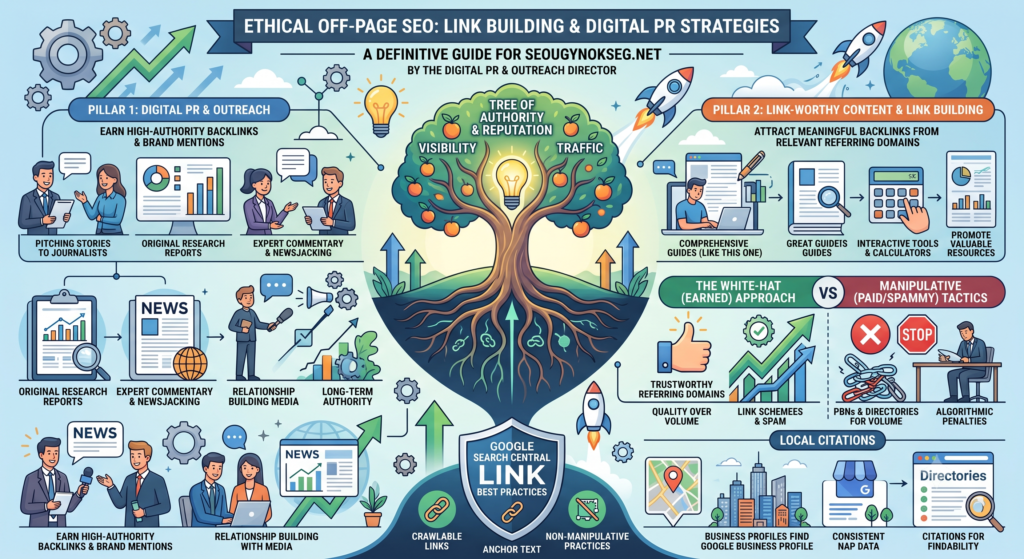
A Definitive Guide for seougynokseg.net
By the Digital PR and Outreach Director
In the ever-evolving landscape of search engine optimization, the tactics we use to establish digital authority have matured significantly. Gone are the days when a website could manipulate its way to the top of search engine results pages (SERPs) through sheer volume of inbound links. Today, search engines, led primarily by Google, are highly sophisticated at differentiating between artificial popularity and genuine authority.
As a Digital PR and Outreach Director, I spend my days navigating this complex ecosystem. My core philosophy—and the central premise of this definitive guide—is that sustainable search visibility requires a strictly ethical, white-hat approach. This guide will walk you through the essential components of modern off-page SEO, detailing how to execute safe link building and digital PR strategies that protect your brand while driving meaningful organic growth.
Understanding Off-Page SEO and the Currency of Trust
To master off-page optimization, we must first define what it actually is. Off-page SEO encompasses all the actions taken outside of your own website to impact your rankings within search engine results pages. While on-page SEO ensures your site is relevant and technically sound, off-page SEO signals to search engines how the rest of the internet perceives your brand. It is the ultimate measure of your website’s reputation and authority.
The primary currency of off-page SEO is the backlink—a hyperlink from an external website pointing back to yours. However, the modern SEO landscape dictates that all links are not created equal.
Why the Referring Domain Matters More Than Volume
In the past, SEO practitioners often obsessed over the raw number of backlinks pointing to a site. Today, the focus has entirely shifted to the quality of the referring domain (the unique website from which the backlink originates).
Search engine algorithms evaluate the authority, relevance, and history of a referring domain to determine how much “link equity” or trust it passes to your site. A single backlink from an authoritative, highly respected industry publication or a major news outlet is worth exponentially more than thousands of links from low-quality, irrelevant directories or web 2.0 blogs.
Why? Because a link from a trustworthy referring domain acts as a genuine editorial endorsement. It tells search engines, “This highly reputable source trusts this website enough to send its own users there.” When you focus on acquiring links from authoritative referring domains, you insulate your website against algorithmic penalties and build a resilient backlink profile that stands the test of time.
Aligning with Google Search Central Link Best Practices
If you want your off-page SEO efforts to be sustainable, your strategies must align seamlessly with search engine guidelines. The definitive rulebook for this is the Google Search Central Link Best Practices documentation.
Google’s guidelines clearly state that any links intended to manipulate a site’s ranking in search results may be considered link spam. This means that to stay on the right side of the algorithms, you must earn your links naturally rather than attempting to manufacture them artificially.
What Constitutes a Meaningful, Crawlable Link?
According to Google Search Central, for a link to effectively pass value and help search engines discover your content, it must be properly formatted and contextually meaningful.
- Crawlability: A link must use proper HTML
<a>tags with a validhrefattribute. JavaScript-based links or links embedded in media files without proper HTML markup may not be crawled or counted. - Contextual Anchor Text: The anchor text (the visible, clickable text in a hyperlink) should concisely and accurately describe the page being linked to. It should provide value to the reader, setting a clear expectation of what they will find when they click. Over-optimizing anchor text by repeatedly using exact-match commercial keywords is a red flag for search engines.
- Relevance: A meaningful link makes logical sense within the context of the content. If a culinary blog links to a financial software company out of nowhere, search algorithms will likely devalue that link, recognizing it as unnatural.
White-Hat vs. Manipulative Tactics
To implement white-hat strategies, you must understand what to avoid. Manipulative tactics—often referred to as black-hat SEO—include buying or selling links that pass PageRank, excessive link exchanges (“link to me and I’ll link to you”), and using automated programs to create links. Participating in Private Blog Networks (PBNs) or paying for undisclosed sponsored posts are also direct violations of Google’s spam policies.
In stark contrast, an ethical approach dictates that you must build relationships and create exceptional content. You cannot buy trust; it must be cultivated. If your content is not inherently link-worthy, no amount of outreach will yield sustainable, high-quality results.
Digital PR: The Heart of Modern Link Building
If traditional link building was about submitting your website to directories and begging webmasters for links, modern link building is about public relations. Digital PR is the strategic process of using traditional PR tactics to earn backlinks, brand mentions, and high-quality traffic from online publications, news sites, and industry blogs.
Digital PR is the safest, most effective way to secure links from the world’s most authoritative referring domains—domains that simply do not sell links or accept low-quality guest posts.
Strategies for Digital PR Success
To succeed in Digital PR, you must give journalists, bloggers, and editors a compelling reason to cover your brand. Here are the core strategies we utilize to promote our clients and earn placements:
1. Data-Driven Journalism and Original Research
Journalists are constantly looking for new data to support their articles. By conducting original research, analyzing public data sets, or surveying your audience, you can create exclusive data points. When you pitch these findings to the media, they will naturally link back to your comprehensive report as the source of the data.
2. Newsjacking and Expert Commentary
Newsjacking involves monitoring breaking news in your industry and quickly offering your brand’s internal experts for commentary. By providing journalists with unique insights, quotes, or contrarian viewpoints on a trending topic, you can secure high-tier media placements.
3. Creating Link-Worthy Assets
Before you can earn a link, you need a destination that justifies it. This means developing link-worthy assets on your website. These can include:
- Definitive guides (like this one)
- Interactive tools and calculators
- Comprehensive infographics
- In-depth industry reports
Once these assets are live, the outreach process involves identifying publishers who have written about similar topics and introducing them to your superior, highly relevant resource.
Earning and Converting Brand Mentions
A highly effective off-page strategy that bridges the gap between traditional PR and SEO is the management of the brand mention. As your Digital PR efforts gain traction, you will frequently find that journalists or bloggers will write about your company, or mention your key personnel, without actually providing a hyperlink back to your site.
While unlinked mentions do have some subtle value in establishing entity authority, a linked mention provides direct SEO value. An ethical outreach strategy involves monitoring the web for unlinked brand mentions and politely contacting the author or editor. You simply thank them for the coverage and ask if they would consider adding a link to your homepage or a relevant resource to help their readers find more information. Because the author already knows and likes your brand enough to write about it, the conversion rate on these requests is exceptionally high.
Local SEO and the Power of the Citation
While Digital PR focuses on massive, authoritative publications, local businesses must also engage in a very specific type of off-page SEO to capture regional search traffic. This is where the concept of the local citation becomes critical.
A citation is any online reference to your business’s Name, Address, and Phone number (commonly referred to as NAP data). Unlike standard backlinks, citations do not always need to include a hyperlink to be valuable, though a link is certainly a bonus.
How to Cite Your Business Ethically
Search engines use citations to verify the existence, legitimacy, and exact location of a local business. The more consistently your business’s NAP data is listed across the web, the more confident search engines are in serving your business in local search results (such as the Google Local Pack).
To cite your business effectively:
- Focus on Primary Data Aggregators: Ensure your information is correct on major platforms like Google Business Profile, Bing Places, Apple Maps, and Yelp.
- Target Industry-Specific Directories: If you are a law firm, ensure you are cited accurately on FindLaw or Avvo. If you are a contractor, look to HomeAdvisor or Houzz.
- Maintain Absolute Consistency: The most critical aspect of building citations is uniformity. “123 Main St.” and “123 Main Street” might seem identical to a human, but discrepancies can confuse search algorithms.
Ethical citation building involves manually submitting your real, verifiable business information to reputable directories. Manipulative tactics—such as creating fake listings in cities where you do not have a physical office, or stuffing keywords into your business name on directory listings—will eventually trigger local spam filters and result in the suspension of your online profiles.
Conclusion: The Long-Term Value of Ethical SEO
As we look toward the future of search at seougynokseg.net, one thing remains absolutely certain: search engines will continue to refine their ability to reward genuine authority and penalize manipulation.
The strategies outlined in this guide—creating genuinely link-worthy content, executing sophisticated digital PR campaigns, converting the unlinked brand mention, and meticulously managing every local citation—are not quick fixes. They require significant time, creativity, and resources.
However, by committing to an ethical, white-hat approach, you are doing much more than just optimizing for an algorithm. You are building real-world brand awareness, establishing your company as a thought leader, and earning the trust of your target audience. When you focus on acquiring links from authoritative, trustworthy sources because your content truly deserves it, your off-page SEO efforts will yield compounding returns, securing your digital visibility for years to come.