A Comprehensive Best-Practices Guide by seougynokseg.net
In the modern digital landscape, the days of manipulating search rankings through keyword stuffing and hidden text are long gone. Today, search engines like Google have evolved to prioritize one fundamental element above all else: the human being on the other side of the screen. As a Senior On-Page SEO Specialist, I constantly emphasize to our clients at seougynokseg.net that achieving top-tier search visibility is no longer just about feeding data to algorithms; it is about engineering a flawless, frictionless journey for your audience.
This guide dives deep into the intricate relationship between on-page SEO, technical performance metrics like Core Web Vitals, and the overarching user experience. By understanding how to optimize these elements, you can bridge the gap between merely attracting traffic and actively driving meaningful business growth.
The Dual Purpose of On-Page SEO
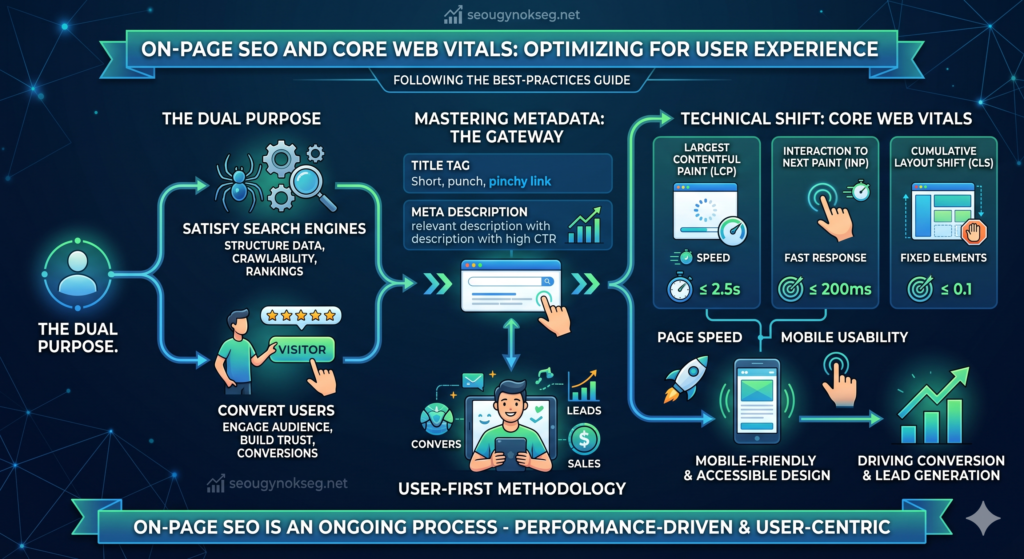
Historically, webmasters viewed SEO as a checklist of tasks performed strictly for search engine crawlers. However, true on-page SEO serves a dual, intertwined purpose: satisfying search engine algorithms while simultaneously engaging and converting human users.
When you structure your website logically, you make it easier for Googlebot to crawl and index your content. But equally important, a well-structured page helps a human visitor find the information they need without frustration. When you publish high-quality, relevant content, you signal topical authority to search engines, while concurrently building trust with the reader.
This dual purpose is the foundation of a user-first methodology. Search engines are highly sophisticated reflection mechanisms; their algorithms are designed to measure, interpret, and reward what users genuinely find valuable. Therefore, when you improve the usability of your website, you are inherently improving your SEO. The ultimate goal is to seamlessly guide a visitor from the search engine results page (SERP) all the way through to conversion, proving to both the algorithm and the user that your site is the definitive answer to their query.
Mastering Metadata: The Gateway to Your Website
Before a user ever experiences your website’s layout, speed, or content, they interact with your site via the SERPs. This initial interaction is governed by your metadata. While metadata might seem like a relic of older SEO practices, it remains the absolute frontline of your organic search strategy. It is your digital storefront, your elevator pitch, and your primary tool for influencing Click-Through Rates (CTR).
The Title Tag: Your Most Critical Headline
The title tag is arguably the most important on-page SEO element after the main body content. It tells search engines what the page is about and dictates the clickable blue link users see in search results.
To craft a compelling title tag that drives traffic, adhere to these best practices:
- Keyword Placement: Place your primary target keyword as close to the beginning of the title tag as possible. This provides immediate relevance to both the user’s query and the search engine.
- Length Constraints: Keep your title tags between 50 to 60 characters (or around 600 pixels). If a title tag is too long, Google will truncate it with an ellipsis (…), which can cut off vital context and reduce CTR.
- Brand Authority: If space permits, append your brand name at the end of the title tag (e.g., ” – seougynokseg.net”) to build brand recognition over time.
- Psychological Triggers: Use modifiers that appeal to user intent. Words like “Guide,” “Review,” “Best,” “2024,” or “Step-by-Step” can significantly boost clickability by setting clear expectations.
The Meta Description: Your Organic Ad Copy
While Google has explicitly stated that the meta description is not a direct ranking factor, its impact on CTR makes it a crucial indirect ranking factor. A high CTR tells search engines that your result is highly relevant to the searcher’s intent.
Think of the meta description as organic ad copy. Best practices include:
- Action-Oriented Language: Start with strong verbs like “Discover,” “Learn,” “Explore,” or “Find.”
- Accurate Summarization: Clearly describe what the user will find on the page. Misleading meta descriptions will lead to high bounce rates, which negatively impacts your overall user experience metrics.
- Highlight Unique Selling Propositions (USPs): Why should the user click your link instead of the nine others? Mention free shipping, expert authorship, or comprehensive data.
- Optimal Length: Aim for 150 to 160 characters. Like title tags, excessively long descriptions will be truncated.
By mastering metadata, you ensure that the very first touchpoint a user has with your brand is clear, enticing, and professionally executed.
The Technical Shift: Core Web Vitals and Page Speed
Once you successfully persuade a user to click your link via optimized metadata, the clock starts ticking. The transition from the SERP to your actual website introduces the technical side of the user experience. In recent years, Google quantified this experience by rolling out Core Web Vitals—a specific set of metrics designed to measure the speed, responsiveness, and visual stability of a page.
A fast-loading website is no longer a luxury; it is a baseline expectation. If a page takes too long to render, users will simply hit the back button, a phenomenon known as “pogo-sticking,” which strongly signals to search engines that your site provides a poor experience.
Let’s break down the three pillars of Core Web Vitals:
1. Largest Contentful Paint (LCP): Measuring Loading Performance
LCP measures how long it takes for the largest piece of content (usually a hero image, video, or a large block of text) to render on the screen. It is a direct indicator of perceived page speed.
- The Benchmark: An ideal LCP is 2.5 seconds or faster.
- How to Improve: Optimize and compress your images, utilize modern image formats like WebP, implement lazy loading for non-critical assets, and upgrade your server response times through caching and Content Delivery Networks (CDNs).
2. Interaction to Next Paint (INP): Measuring Responsiveness
Replacing the older First Input Delay (FID) metric, INP measures the overall responsiveness of a page to user interactions (clicks, taps, keyboard inputs) throughout the entire lifecycle of their visit. It ensures the site feels snappy and reactive.
- The Benchmark: An INP of 200 milliseconds or less is considered good.
- How to Improve: Minimize heavy JavaScript execution, break up long main-thread tasks, and ensure that third-party scripts (like analytics or chat widgets) do not monopolize the browser’s resources.
3. Cumulative Layout Shift (CLS): Measuring Visual Stability
Have you ever tried to click a button on a website, only for the page content to suddenly shift downward, causing you to click an ad instead? That frustrating experience is exactly what CLS measures. It quantifies unexpected layout shifts during the lifespan of the page.
- The Benchmark: A CLS score of 0.1 or less is optimal.
- How to Improve: Always include explicit width and height size attributes on your images and video elements. Avoid injecting content dynamically above existing content, and ensure web fonts are preloaded to prevent “Flash of Unstyled Text” (FOUT) which causes text blocks to change size.
When your site is technically sound and meets these Core Web Vitals benchmarks, it becomes inherently accessible and enjoyable to navigate, paving the way for deeper engagement.
Mobile Usability: The Non-Negotiable Standard
In a digital ecosystem where mobile devices account for over half of all global web traffic, maintaining a mobile-friendly website is an absolute necessity. Google operates on a mobile-first indexing system, meaning it predominantly uses the mobile version of your website’s content for indexing and ranking. If your site performs beautifully on a desktop but breaks on a smartphone, your organic search visibility will plummet.
Mobile usability goes beyond simply fitting your content onto a smaller screen. It requires a fundamental shift in design philosophy:
- Responsive Web Design: Your site must fluidly adapt to any screen size, whether it’s a large desktop monitor, a tablet, or a compact smartphone.
- Touch-Friendly Navigation: Links and buttons must be appropriately sized and spaced so users can easily tap them with their thumbs without accidentally clicking the wrong element (known as optimizing the “touch targets”).
- Legible Typography: Text must be readable without requiring the user to pinch and zoom. Base font sizes should be large enough, with adequate line spacing, to ensure readability on small, brightly lit screens.
- Intrusive Interstitials: Avoid massive pop-ups that obscure the main content on mobile devices. Google actively penalizes sites that use intrusive interstitials because they ruin the mobile user experience.
By prioritizing mobile usability, you ensure that your site is accessible to users wherever they are, capturing traffic that competitors with outdated, desktop-only designs are leaving on the table.
Connecting UX to Conversion and Lead Generation
The ultimate objective of any commercial website is not just to generate traffic, but to drive revenue. This is where the intersection of on-page SEO, technical performance, and user experience yields its highest dividends.
When a website is secure, fast-loading, logically structured, and mobile-friendly, it removes the cognitive friction that often prevents a user from taking action. A seamless, frictionless environment inherently builds trust. If a user finds your site via a well-crafted title tag, experiences an immediate LCP, and navigates your mobile interface with zero layout shifts, they feel confident in your brand’s professionalism.
This trust directly correlates with lead generation and conversion rates.
- Reducing Bounce Rates: By providing exactly what was promised in your meta description and delivering it instantly via optimized page speed, users stay on the page longer.
- Guiding the Funnel: Strong on-page SEO relies on clear header hierarchies (H1, H2, H3 tags) and strategic internal linking. This logical structure guides the user naturally toward your Calls to Action (CTAs), making it easier to convert them from a passive reader into a paying customer or qualified lead.
- Retargeting and Returning Users: A positive user experience ensures that even if a visitor doesn’t convert on the first visit, they are far more likely to return or respond positively to retargeting campaigns.
Ultimately, optimizing for search engines and optimizing for conversion are two sides of the same coin. When you serve the user, you serve the algorithm, and in turn, you serve your bottom line.
Conclusion: A Commitment to Continuous Optimization
As a final note from seougynokseg.net, it is critical to understand that on-page SEO and technical optimization are not one-time tasks to be crossed off a launch checklist. On-page SEO is an ongoing process. Search engine algorithms update thousands of times a year, user behaviors shift, and web technologies constantly evolve. Do not expect overnight results or instant first-page rankings from a single round of metadata tweaks. True, sustainable organic growth requires a steadfast commitment to performance-driven, user-centric optimization.
By consistently monitoring your Core Web Vitals, refining your title tags and meta descriptions, ensuring flawless mobile usability, and always keeping the human user at the center of your strategy, you will build a digital asset that not only dominates the search results but consistently converts traffic into tangible business success.