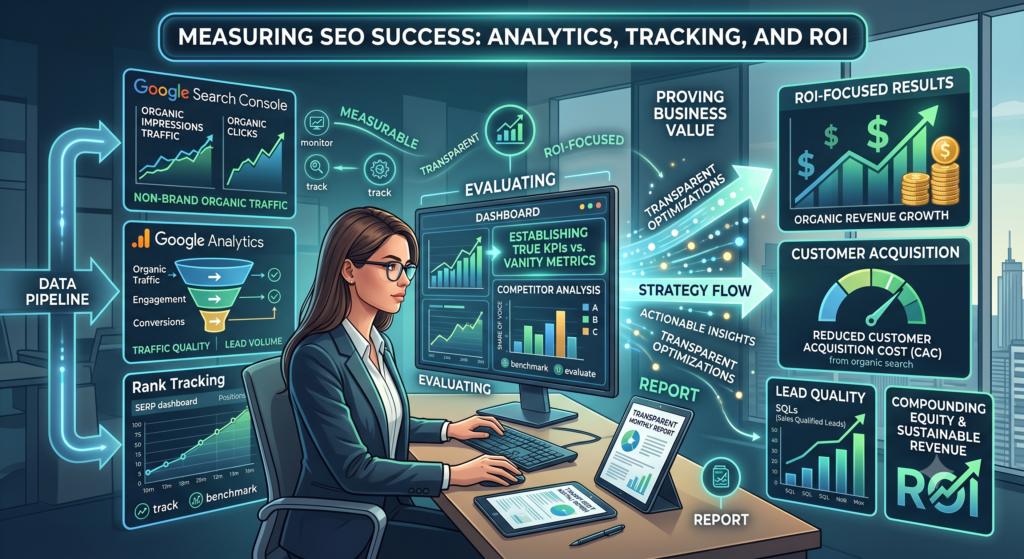
As an SEO Data Analyst, one of the most frequent conversations I have with business owners, stakeholders, and investors begins with a fundamental question: “How do we know this is actually working?” For years, search engine optimization was treated by some as a digital dark art—a black box where budgets entered and, hopefully, traffic emerged. However, in today’s highly sophisticated digital ecosystem, that outdated narrative is not only false, but it is also detrimental to business growth.
At seougynokseg.net, we believe that SEO is a deeply quantitative, scientific process. It is a highly measurable, roi-focused marketing channel that, when properly tracked, delivers some of the highest returns on investment in the digital marketing landscape. To prove the value of SEO, agencies and internal teams must establish accurate tracking infrastructures, define the right metrics, and translate technical data into tangible business revenue.
This comprehensive guide will demystify SEO reporting, detailing how we measure, monitor, track, report, benchmark, and evaluate organic search performance.
Demystifying SEO Reporting: From Black Box to Glass House
The foundation of any successful SEO campaign is a transparent data infrastructure. Investors and business owners need absolute confidence that their capital is being deployed effectively. SEO reporting should never be a confusing data dump of jargon; rather, it should be a clear, strategic narrative that connects technical optimizations directly to bottom-line revenue.
To achieve this, we must shift the conversation away from algorithmic guesswork and toward empirical data analysis. Search engines operate on complex algorithms, yes, but the outcomes of those algorithms—impressions, clicks, user behavior, and conversions—are entirely trackable. By establishing a rigorous analytics framework, we ensure stakeholder alignment from day one, setting clear expectations about how organic visibility translates into leads, sales, and sustainable market share.
The Core Tech Stack: Google Analytics and Google Search Console
To accurately evaluate the impact of an SEO campaign, a data analyst relies on a specialized tech stack. The two most critical pillars of this foundation are Google Search Console and Google Analytics. While they are often mentioned in the same breath, they serve distinctly different, yet highly complementary, purposes.
Google Search Console (GSC): The Pre-Click Ecosystem
Google Search Console is the definitive source of truth for how a website performs before a user actually lands on the page. It provides a direct line of communication with Google’s search engine, allowing us to monitor our organic footprint with precision.
In GSC, we track critical metrics such as:
- Search Impressions: How often a site appears in search results.
- Organic Clicks: How many users click through to the site.
- Click-Through Rate (CTR): The percentage of impressions that result in a click, serving as a key indicator of title tag and meta description effectiveness.
- Average Position: The average ranking for specific queries.
More importantly, GSC allows us to segment data by exact search queries, devices, and geographic locations. This enables analysts to isolate non-brand search terms from brand search terms—a critical distinction we will cover when discussing KPIs.
Google Analytics (GA4): The Post-Click Ecosystem
Once a user clicks on a search result and enters the website, Google Analytics takes over. GA4 allows us to map the user journey from the initial landing page all the way to the final conversion.
For an SEO data analyst, GA4 is used to evaluate:
- Traffic Quality: Are organic visitors staying on the site, engaging with the content, and visiting multiple pages?
- Event Tracking: Are users taking desired actions, such as downloading whitepapers, submitting contact forms, or adding products to their carts?
- Attribution Modeling: How does organic search assist other channels (like Paid Search or Social) in the conversion path?
By integrating Google Search Console directly into Google Analytics, we bridge the gap between pre-click visibility and post-click profitability, creating a closed-loop system for accurate performance measurement.
Defining Success: KPIs vs. Vanity Metrics
One of the greatest pitfalls in SEO reporting is the misidentification of success metrics. To maintain stakeholder trust, we must establish a clear distinction between a true Key Performance Indicator (KPI) and a vanity metric.
The Trap of Vanity Metrics
A vanity metric is a data point that looks good on paper but has no correlation with business growth or revenue. Common examples in the SEO industry include:
- Total Raw Traffic: A massive spike in traffic means nothing if the visitors are from outside your serviceable geographic area or have zero intent to purchase.
- Meaningless Keyword Rankings: Ranking #1 for a high-volume keyword is a classic vanity metric if that keyword does not bring in qualified buyers.
- Pageviews: High pageviews could simply indicate that users are lost on your website and cannot find what they are looking for.
Establishing True KPIs
A true KPI is deeply tied to the commercial goals of the business. An roi-focused SEO campaign will measure success through the following indicators:
- Non-Brand Organic Traffic: This is perhaps the most vital top-of-funnel KPI. Brand traffic (users searching for your specific company name) generally reflects the success of your overall brand awareness and PR efforts. Non-brand organic traffic (users searching for your products or services without knowing who you are) is the true measure of SEO success. It proves that the campaign is capturing new market share.
- Lead Quality and Volume: We do not just want forms filled out; we want qualified prospects. By passing organic lead data into a CRM (like Salesforce or HubSpot), we can track how many organic leads transition into Sales Qualified Leads (SQLs) and, ultimately, closed-won deals.
- Organic Conversion Rate: What percentage of organic visitors complete a transaction or meaningful goal? An increasing conversion rate indicates that the SEO strategy is successfully targeting high-intent, transactional keywords.
- Customer Acquisition Cost (CAC) via SEO: By dividing the total cost of the SEO campaign (agency fees, content creation, technical resources) by the number of new customers acquired through organic search, we can directly compare SEO’s efficiency against paid acquisition channels.
The Strategic Role of Rank Tracking and Competitor Analysis
While I have cautioned against treating random keyword rankings as the ultimate goal, rank tracking remains an essential diagnostic tool when used correctly. As an SEO Data Analyst, I do not look at single keywords in isolation; I look at keyword clusters and topic categories.
By utilizing advanced rank tracking software, we can monitor search visibility across hundreds or thousands of strategically grouped terms. This allows us to spot algorithmic shifts, identify cannibalization issues, and understand which content silos are driving the most value.
Equally important is ongoing competitor analysis. SEO does not happen in a vacuum; it is a zero-sum game played on a dynamic search engine results page (SERP). If your organic traffic drops, it is crucial to know whether you lost visibility due to a technical error on your site, an algorithmic update, or because a competitor out-published you.
Rigorous competitor analysis allows us to benchmark our client’s performance against industry rivals. We analyze competitors’ backlink velocity, content gaps, and technical site structures. By understanding exactly what the competition is doing, we can forecast the resources required to overtake them and capture their market share. We measure the “Share of Voice” in the SERPs to show investors exactly where the company stands within the broader industry landscape.
The Anatomy of a Transparent Monthly Report
All of this data collection and analysis culminates in the deliverable that bridges the gap between the SEO agency and the executive board: the monthly report.
A poor monthly report is an automated PDF exported from a single tool, filled with charts that offer no context. A transparent, high-value monthly report is a curated, analytical document that tells a story. Business owners should expect to see the following in their monthly reviews:
- Executive Summary: A high-level overview of the month’s performance, highlighting the most critical wins, challenges, and ROI figures in plain business language.
- Progress Against KPIs: A clear visualization of how the campaign is pacing against the predefined goals (e.g., Non-brand organic traffic growth, SQLs generated).
- Work Completed: Total transparency regarding what the SEO team actually did that month—which technical audits were performed, what content was published, and what off-page link-building was executed.
- Data Deep-Dive: Insights drawn from analytics platforms. For example, “We noticed a 15% increase in CTR on our core service pages after deploying schema markup, which resulted in 22 net-new conversions.”
- Strategic Roadmap (Next Steps): Based on the data we evaluate, what are the actionable next steps for the upcoming month? SEO is an agile process, and the report should outline how the strategy is adapting to new data.
By providing this level of detail, agencies reassure stakeholders that every dollar spent is being actively managed and optimized.
Connecting the Dots: Linking Organic Visibility to ROI
The ultimate goal of an SEO Data Analyst is to answer the final, most crucial question: “What is our ROI?” Connecting organic visibility directly to ROI requires a closed-loop attribution system. Here is how we build that bridge:
First, we assign a monetary value to our conversions. For an e-commerce site, this is straightforward, as Google Analytics can pull in exact transaction revenues. For B2B or lead-generation sites, we work with stakeholders to determine the average Lifetime Value (LTV) of a client and the average close rate of a lead.
If an SEO campaign costs $5,000 per month, and we track that organic search generated 100 leads, with a 10% close rate (10 new clients) and an average LTV of $5,000 per client, the organic channel has generated $50,000 in future revenue. That represents a 10x ROI.
When we report on these metrics, SEO transitions from being viewed as a “marketing expense” to being recognized as a high-yield capital investment. We can demonstrate that unlike paid advertising—where traffic immediately stops the moment you turn off the budget—SEO builds compounding equity over time. A well-optimized piece of content can continue to generate highly qualified, roi-focused traffic for years without requiring an additional per-click fee.
Conclusion
At seougynokseg.net, we understand that modern businesses cannot afford to invest in marketing channels based on faith alone. By leveraging sophisticated analytics, tools like Google Search Console, and rigorous competitor analysis, we ensure that every aspect of an SEO campaign is measurable and transparent.
By moving past vanity metrics and focusing strictly on business-driven KPIs, accurate tracking, and comprehensive monthly reporting, we empower business owners and investors to see SEO for what it truly is: a predictable, data-driven engine for sustainable revenue growth and long-term ROI.