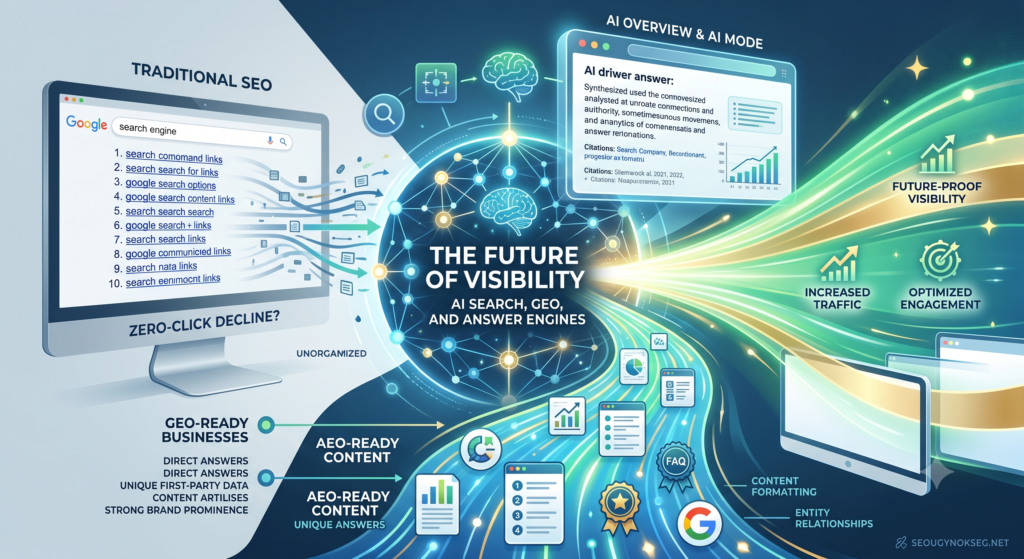
To understand where we are going, we must understand the metamorphosis of Google Search. What began as a simple retrieval system evolved into a semantic engine (with the Hummingbird and RankBrain updates), and has now blossomed into an intelligent, generative oracle.
Today, Google is rapidly integrating generative AI directly into the search engine results page (SERP). The most prominent manifestation of this is AI Overviews (formerly known as the Search Generative Experience, or SGE). When a user types a complex query, they are no longer immediately greeted by a list of websites. Instead, an AI Overview provides a synthesized, conversational answer drawn from multiple sources across the web, complete with drop-down citations and context-rich summaries.
Furthermore, the introduction of a dedicated AI mode allows users to converse with the search engine dynamically. In AI mode, search becomes a multi-turn dialogue. The user asks a follow-up question, refines their parameters, and the engine remembers the context of the previous query. It is a highly personalized, deeply interactive experience that mimics consulting a knowledgeable human expert.
For businesses, this evolution introduces a terrifying, yet exhilarating, reality: zero-click searches will rise exponentially. If the search engine provides the complete answer within the AI Overview, the user has no need to click through to your website. Consequently, traditional organic traffic will evolve. But this does not mean the end of SEO; rather, it means the metrics of success are changing. Visibility in the generative era means being the source material that powers the AI’s response. If you are not in the AI’s reference pool, you do not exist in the modern user journey.
Defining the New Lexicon: GEO and AEO
As the mechanics of search change, so too does our terminology. To become truly future-proof, marketers must understand and integrate two critical disciplines: Generative Engine Optimization and Answer Engine Optimization.
Generative Engine Optimization (GEO)
Generative engine optimization is the holistic practice of optimizing your content, brand presence, and digital footprint so that Large Language Models (LLMs) like Google’s Gemini, OpenAI’s ChatGPT, and Anthropic’s Claude confidently cite your brand as an authoritative source in their generative responses.
GEO differs from traditional SEO in its ultimate objective. SEO aims to rank a URL for a specific keyword. GEO aims to embed an idea, a statistic, or a brand into the latent space of an AI model. To be geo-ready, your content must be highly contextual, rich in semantic meaning, and backed by diverse, authoritative citations. The AI must understand not just what your page says, but how your brand connects to the broader web of knowledge in your industry.
Answer Engine Optimization (AEO)
While GEO is the overarching strategy for generative AI, Answer engine optimization is its highly tactical subset. AEO focuses specifically on formatting and structuring content to provide direct, concise, and undeniable answers to explicit user queries (the Who, What, Where, When, Why, and How).
AI models, and the AI Overviews they power, crave structured, unambiguous data. They want to extract the exact answer to a user’s question without wading through thousands of words of marketing fluff. To be aeo-ready, you must anticipate the questions your audience will ask and provide the answers in a format that a machine can easily parse—using bullet points, numbered lists, data tables, and explicit FAQ schemas.
The Blueprint for an AI-Search-Ready Strategy
The shift to ai search does not invalidate everything we know about marketing. In fact, foundational SEO still strongly applies. Crawlability, indexability, site speed, and technical architecture remain the baseline requirements for entry. If the search engine cannot access or understand your site, neither can its generative AI.
However, foundational SEO is no longer sufficient on its own. To maintain and grow visibility, content formatting and clear entity relationships are more important than ever. Here is how you must adapt to survive and thrive.
1. Optimize for Direct Answers
The era of burying the lede to force a user to scroll (and view ads) is over. If your content is structured like a recipe blog from 2015—where the actual answer is buried beneath a 1,000-word personal anecdote—the AI will bypass you for a competitor who gets straight to the point.
To optimize for AI Overviews, employ an inverted pyramid writing style. State the direct answer clearly and concisely at the very beginning of your section, using bold text or a summary box. Once the direct answer is established, you can expand on the topic with deeper analysis, context, and nuance. The AI extracts the concise answer for its immediate response and may use your detailed analysis to answer the user’s follow-up questions in AI mode.
2. Leverage Unique First-Party Data
Generative AI models are incredibly adept at regurgitating widely accepted facts. If your blog post merely summarizes what ten other websites have already said, you offer zero value to an AI Overview. The AI already knows the consensus; it doesn’t need your derivative article.
What an LLM cannot invent is unique, proprietary, first-party data. To become indispensable to ai search, you must become a primary source. Conduct original research. Publish surveys. Analyze your internal customer data and release industry reports. Share case studies with concrete, verified metrics. When you publish data that exists nowhere else on the internet, the AI has no choice but to cite your brand when users ask questions related to that data.
3. Establish Strong Brand Prominence and Entity Relationships
In traditional SEO, links were the primary currency of authority. In the age of generative engine optimization, entities are the currency. An entity is a distinct, well-defined concept—it can be a person, a place, a concept, or your brand.
AI models understand the world through a massive, interconnected knowledge graph of entities. Your goal is to strengthen the relationship between your brand entity and the topical entities you want to be known for. How do you do this? Through digital PR, co-occurrence, and expert authorship.
- Mentions matter: Even unlinked mentions of your brand on authoritative industry websites help the AI associate you with your niche.
- Expertise: Ensure your content is authored by recognized experts. The AI evaluates the entity of the author as much as the content itself.
- Clear associations: Use schema markup (like Organization, Person, and Article schema) to explicitly spell out these relationships for the search engine bots.
4. Format Relentlessly for Machine Readability
You must format your content not just for human eyes, but for machine parsing. Break up walls of text. Use semantic HTML correctly (H1, H2, H3 tags in logical order). If you are comparing two products, do not just write paragraphs about them—put the comparison into a cleanly coded HTML table. AI Overviews frequently pull entire tables or bulleted lists directly from websites because they are inherently easy to synthesize.
Aligning with the Google Search Central AI Optimization Guide
As we navigate this transition, we are not flying entirely blind. We must look to official documentation, such as the principles outlined in the Google Search Central AI Optimization Guide, regarding how site owners should prepare.
The guide consistently reinforces one critical theme: the relentless pursuit of high-quality, people-first content. Google’s algorithms are being trained to identify and reward content that demonstrates Experience, Expertise, Authoritativeness, and Trustworthiness (E-E-A-T). In a generative landscape, E-E-A-T is your shield against being ignored.
Furthermore, the guidelines subtly warn against the dangers of AI hallucinations. Generative models sometimes confidently invent facts. To combat this, Google’s AI Overviews prioritize sources that are highly reliable, corroborated, and structurally sound. By adopting a strict geo-ready and aeo-ready methodology—providing clear facts, citing your own sources, and structuring data logically— you drastically reduce the cognitive load on the AI, making your content the safest, most reliable choice to feature.
Conclusion: The Mandate to Evolve
The transition from blue links to AI Overviews and interactive AI mode is not a distant prediction; it is an active, ongoing reality. For the audience of seougynokseg.net and businesses worldwide, the traditional metrics of success—chasing high search volume keywords with generic content—are rapidly losing their efficacy.
To secure your future visibility and traffic, you must become an active participant in this new ecosystem. You must adapt your mindset from “how do I rank for this keyword?” to “how do I become the definitive source of truth for this concept?”
You must comprehensively optimize for generative interfaces by embracing generative engine optimization and answer engine optimization. You must create content that is highly structured, deeply expert, backed by unique first-party data, and incredibly easy for machines to parse.
The businesses that refuse to change will watch their traffic slowly erode as AI Overviews absorb their top-of-funnel queries. But those who choose to become ai-search-ready, formatting their knowledge to feed the answer engines of tomorrow, will unlock unprecedented levels of authority, trust, and brand prominence. The future of search is conversational, intelligent, and generative. It is time to ensure your brand is part of the conversation.