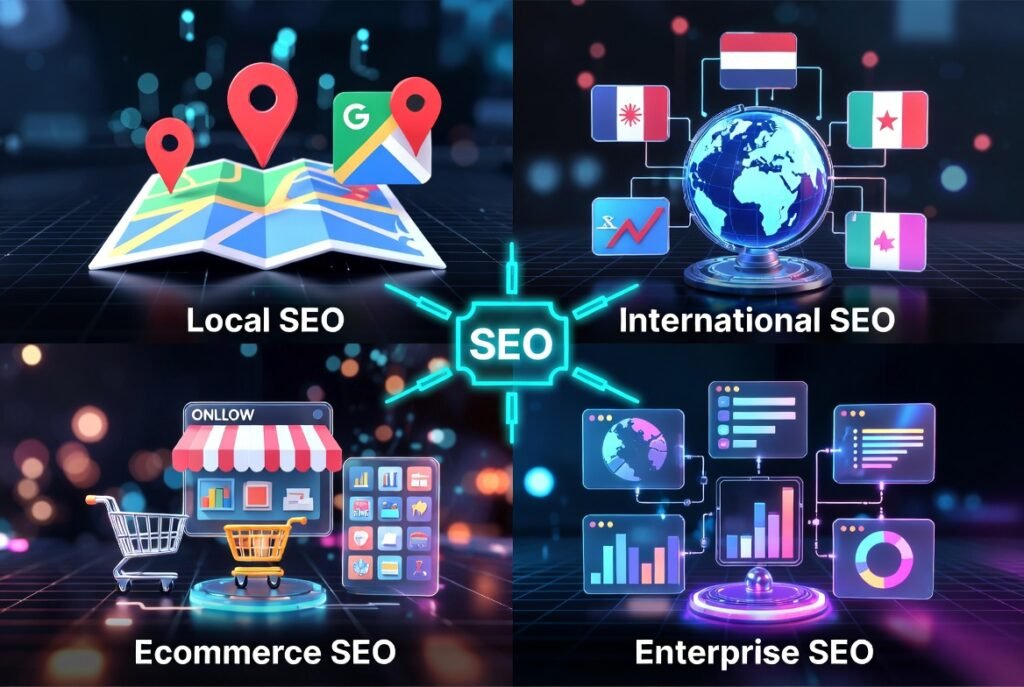
Not all SEO is created equal. A one-size-fits-all approach fails when your business model, scale, and geographic reach differ significantly. Whether you are a franchise owner managing multiple locations, an international marketing director expanding across borders, an ecommerce leader scaling product catalogs, or an enterprise operations executive overseeing millions of pages, your SEO strategy must be tailored to your specific challenges and opportunities.
This comprehensive guide for seougynokseg.net breaks down four major SEO disciplines — Local SEO, International SEO, Ecommerce SEO, and Enterprise SEO — and shows how structured data and schema markup serve as universal foundations across all of them.
1. Local SEO: Dominating Map Packs and Local Intent
For franchise owners and multi-location businesses, Local SEO is the primary driver of foot traffic and regional revenue. Success depends on hyper-local relevance and authority.
Key focus areas:
- Google Business Profile optimization (complete information, regular posts, genuine reviews)
- Consistent NAP (Name, Address, Phone) citations across authoritative directories
- Local schema markup (LocalBusiness, OpeningHours, Reviews)
- Location-specific landing pages with unique content
- Proximity and relevance signals
Map Pack dominance requires strong review signals, accurate business categories, and proximity to searchers. Top-ranking local businesses combine technical accuracy with genuine community engagement.
Pro tip for franchise owners: Create a centralized-local hybrid model where headquarters manages brand consistency while individual locations handle localized content and reviews.
2. International SEO: Scaling Across Borders with Hreflang
International SEO is far more complex than simply translating content. Global marketing teams must address language, cultural nuances, and technical signals that tell search engines which version of a page to serve in each country or language.
Critical technical elements:
- Proper hreflang implementation to avoid duplicate content issues
- Localized URL structures (ccTLDs, subdirectories, or subdomains)
- Localization vs. translation: True localization adapts messaging, examples, currency, and cultural references
- International schema markup and geotargeting in Search Console
- Local hosting or CDN considerations for speed
International SEO success demands understanding regional search behavior. A page that ranks well in Hungary may need significant adaptation for German, UK, or US audiences.
Common pitfall: Using automatic translation tools without human oversight, which harms both user experience and E-E-A-T signals.
3. Ecommerce SEO: Optimizing for Product Discovery and Conversions
Ecommerce SEO requires managing massive catalogs while creating exceptional user experiences that drive sales. The challenge lies in balancing crawl efficiency with rich, commercial content.
Key strategies:
- Optimized category and collection pages with unique, value-driven content
- Proper handling of faceted navigation (avoiding thin filtered pages)
- Robust product schema markup (Product, Offer, Review, AggregateRating)
- Internal linking architecture that distributes authority to high-value products
- Image optimization and structured data for rich results (price, availability, ratings)
Successful ecommerce SEO turns complex catalogs into discoverable, trustworthy shopping experiences. Fast-loading PDP (Product Detail Pages), clear USPs, and strong schema implementation directly impact both rankings and conversion rates.
4. Enterprise SEO: Managing Scale, Governance, and Complexity
Enterprise SEO involves coordinating SEO efforts across thousands or millions of pages, multiple teams, and complex stakeholder landscapes. Large organizations face unique challenges around scalability, brand consistency, and technical governance.
Core enterprise requirements:
- Centralized yet flexible SEO governance frameworks
- Advanced technical infrastructure (log file analysis, crawl budget management)
- Scalable content strategies and templated optimization
- Cross-departmental collaboration (SEO, development, content, legal)
- Sophisticated analytics and reporting dashboards
Enterprise SEO leaders must implement robust processes for content audits, technical debt reduction, and migration risk management. The ability to maintain quality at scale separates successful enterprise programs from fragmented efforts.
The Universal Power of Structured Data and Schema Markup
Across all four disciplines, structured data and schema markup act as the common technical thread that helps search engines understand complex websites:
- LocalBusiness + OpeningHours for local SEO
- Organization + WebSite + BreadcrumbList for enterprise clarity
- Product + Offer + AggregateRating for ecommerce
- Article + FAQPage + HowTo for content-heavy international sites
Well-implemented schema improves rich results, enhances AI understanding, and provides clearer entity signals. It is one of the highest-ROI technical investments any organization can make.
Choosing and Implementing the Right SEO Approach
- Franchise owners: Prioritize Local SEO with strong central governance.
- International marketing teams: Invest in proper hreflang and true localization.
- Ecommerce leaders: Focus on product schema, category optimization, and technical scalability.
- Enterprise executives: Build robust governance, scalable processes, and cross-functional alignment.
In every case, schema-ready architecture and user-first experiences provide the foundation for sustainable success.
Specialized SEO requires deep understanding of your business model, target audience, and technical capabilities. Whether you operate locally, globally, through ecommerce, or at enterprise scale, success depends on adapting strategies while maintaining strong foundational principles.
The most effective organizations combine local, international, ecommerce, and enterprise best practices through unified technical excellence — particularly structured data and schema markup — while delivering genuinely helpful experiences to users.
By aligning your SEO program with your specific business reality, you create sustainable competitive advantages that drive long-term organic growth, better user experiences, and stronger business results.