The Myth of the “One-Time Fix”
For years, the industry was plagued by the misconception that search optimization was a one-and-done endeavor. A brand would launch a website, hire a firm to “SEO it,” and walk away expecting permanent results.
In reality, the internet is aggressively dynamic. Competitors publish new content, consumer search behaviors shift, and search engines continuously refine their algorithms to surface the most relevant, authoritative answers. If your website remains static, it decays.
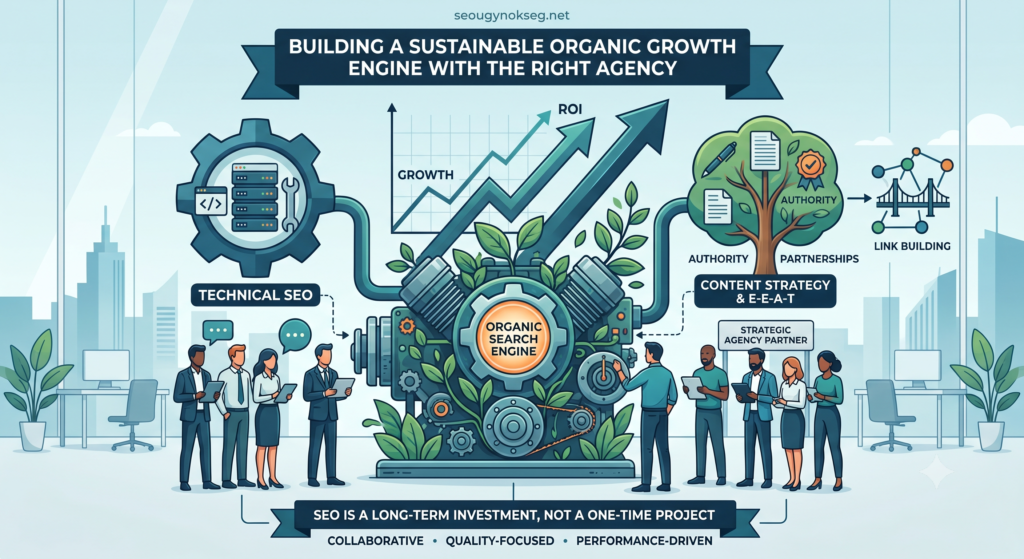
Building an organic engine requires a long-term commitment. It involves constructing a system where technical health, topical authority, and digital reputation feed into one another. When these elements operate in harmony, the result is a flywheel effect: higher visibility leads to more traffic, which generates more data, which informs better content, which attracts more authoritative links.
The Three Pillars of a Sustainable SEO Engine
A performance-driven SEO strategy cannot rely on a single tactic. It requires a holistic mastery of three core pillars. If one pillar crumbles, the entire structure becomes compromised.
1. Technical SEO: The Unshakable Foundation
Even the most brilliant content will fail if search engines cannot find, crawl, and understand it. Technical SEO ensures that your digital infrastructure is flawless.
However, identifying technical issues is only 10% of the battle. The true differentiator between a mediocre vendor and a top-tier search engine optimization agency is how they handle implementation speed. An audit sitting in a developer’s backlog for six months generates zero return. A strategic partner will work directly with your development team to bypass bottlenecks, troubleshoot server-side issues, and ensure that critical fixes—from Core Web Vitals to complex schema markup—are deployed efficiently.
2. Content Strategy and Governance: Demonstrating E-E-A-T
Content is the vehicle through which you communicate value to both your audience and search engines. But churning out hundreds of low-quality, AI-generated articles is a recipe for algorithmic penalty. Modern content strategy is rooted in E-E-A-T (Experience, Expertise, Authoritativeness, and Trustworthiness).
A strong agency partner understands that your content must be fundamentally better, more insightful, and more helpful than what currently ranks. Furthermore, they introduce the concept of content governance. This means establishing clear editorial standards, regular auditing cycles, and content pruning. Governance ensures that every piece of content on your site—whether published yesterday or five years ago—remains accurate, aligned with your brand voice, and valuable to the user.
3. Ethical Link Building: Cultivating True Authority
Links remain a primary currency of trust on the web, but the methodology for acquiring them has evolved drastically. Buying link blasts or participating in private blog networks (PBNs) will inevitably lead to manual penalties and a decimated organic presence.
Ethical link building is essentially digital public relations. It involves creating linkable assets—such as proprietary research, tools, or deep-dive guides—and conducting personalized outreach to earn placements on highly authoritative, relevant publications. It is a slow, methodical process, but it is the only way to build a backlink profile that withstands algorithm updates and drives genuine referral traffic.
The Role of a Strategic, Collaborative Partner
Many agencies operate as order-takers. You ask for ten articles and five links, and they deliver exactly that, regardless of whether it moves the needle. A true partner operates differently. They do not sell deliverables; they sell business outcomes.
To turn SEO into a revenue-generating asset, your agency must be deeply collaborative. This requires a proven operational methodology:
- Align: Before a single keyword is researched, the agency must align their organic roadmap with your broader business objectives. If your highest-margin product is enterprise software, ranking for low-intent, top-of-funnel consumer terms is a vanity metric. Your partner must understand your sales cycle, your target personas, and your revenue targets to ensure that every effort contributes to a tangible ROI.
- Prioritize: In any enterprise-level SEO campaign, there will be hundreds of potential tasks. A strategic partner knows how to prioritize the highest-impact actions. They will not waste your resources tweaking meta descriptions on low-value pages when there is a critical site architecture issue preventing your main product pages from being indexed.
- Execute: Ideas are cheap; execution is everything. The right agency bridges the gap between strategy and reality. Whether it is briefing writers, conducting technical QA, or running outreach campaigns, they execute with precision, speed, and a relentless focus on quality.
- Review: Search is not static, and neither should be your strategy. A top-tier agency will continuously review performance data against the initial baseline. They analyze what is working, pivot away from what isn’t, and transparently report on the metrics that actually matter to your bottom line (conversions, lead quality, and pipeline velocity), rather than just traffic volume.
Redefining ROI in Organic Search
Ultimately, the goal of this entire ecosystem is to generate a measurable, compounding ROI. Unlike paid advertising, where your traffic drops to zero the moment you stop funding the campaign, organic search is an investment in equity.
When you build a highly optimized, authoritative website, you are building a digital asset that works for you 24/7. The upfront costs of high-quality content and technical overhauls may be higher than deploying a quick PPC campaign, but the long-term cost per acquisition (CPA) drops dramatically over time. As your authority grows, ranking for new, highly competitive terms becomes progressively easier and cheaper.
A quality-focused agency understands this financial reality. They will help you forecast realistic growth, set proper expectations with your stakeholders, and consistently prove the financial value of their work.
Conclusion: The Path Forward
Building a sustainable organic growth engine is not for the faint of heart. It requires a fundamental commitment to quality, a willingness to invest in the long game, and the courage to ignore the siren song of quick hacks.
As you evaluate your options on seougynokseg.net, remember this: true authority growth requires patience, human-reviewed strategies, and strict adherence to search engine guidelines. Do not settle for a vendor who promises overnight success. Seek out a partner who asks the hard questions about your business model, who pushes back when necessary, and who is dedicated to building an unshakable digital foundation.
If you are ready to stop renting your traffic and start owning your digital market share, it is time to invest in a strategic SEO partnership. Commit to the process, prioritize the user experience, and watch as your organic engine transforms your business.
Final FAQ: The SEO Lifecycle Summarized
Q: How long does it take to see a measurable ROI from organic search?A: While technical fixes can yield quick wins (often within 4-8 weeks), a comprehensive SEO strategy typically requires 6 to 12 months to show significant, compounding ROI. It is a long-term investment that builds equity over time, unlike the immediate (but temporary) traffic of paid ads.
Q: Why is E-E-A-T so critical for modern content strategy?A: Search engines are actively battling a flood of low-quality, automated content. By demonstrating Experience, Expertise, Authoritativeness, and Trustworthiness, you signal to algorithms and users alike that your content is reliable, accurate, and created by subject matter experts. It is the core of future-proofing your site.
Q: If we have a strong in-house development team, why do we need an agency for Technical SEO?A: Developers are experts at building websites; SEOs are experts at ensuring search engines can interpret them. An agency bridges the gap by providing developers with specific, prioritized, and search-compliant blueprints, ensuring that code updates enhance crawlability rather than accidentally blocking search bots.
Q: What is the difference between toxic link building and ethical link building?A: Toxic link building relies on manipulation—buying links on irrelevant sites, using private networks, or spamming directories—which leads to penalties. Ethical link building focuses on creating genuinely valuable digital assets and using outreach/digital PR to earn mentions from authoritative, editorially rigorous publications.
Q: How do we know if our SEO agency is truly acting as a strategic partner?A: A strategic partner talks about business metrics (revenue, lead quality, customer acquisition cost) rather than just vanity metrics (clicks, impressions). They actively align their roadmap with your business goals, prioritize high-impact tasks, and are transparent in their review and reporting processes.