In today’s hyper-competitive digital ecosystem, having a beautifully designed website is no longer enough to guarantee business success. If your ideal customers cannot find you when they actively look for the solutions you provide, your website is essentially a billboard hidden in the desert. For business owners and founders, navigating the complex algorithms that dictate online visibility can be daunting. This is where a specialized partner steps in.
But what exactly does an SEO agency do?
This comprehensive guide, brought to you by seougynokseg.net, will demystify the mechanics of organic growth, outline the distinct roles within an SEO team, and explain the step-by-step journey these experts take to transform your website into a revenue-generating asset.
Defining the SEO Agency: More Than Just Traffic
At its core, a search engine optimization agency is a specialized firm dedicated to improving a website’s visibility in unpaid search results. While paid advertising (PPC) operates like a faucet—delivering traffic only as long as you keep paying for it—SEO is an investment in digital real estate. An SEO company builds the foundation, architecture, and authority required to capture high-intent traffic consistently over time.
The primary objective of an SEO partner is to help your business capture demand through organic search. When a potential customer types a query into a search engine, the agency’s goal is to ensure your web pages appear at the very top of those results. By doing so, they connect your business with users exactly when they are looking to make a purchase, hire a service, or consume information.
A reputable agency operates on a foundation that is highly strategic, focusing not just on vanity metrics like raw traffic, but on aligning search visibility with your overarching business goals, such as lead generation and customer acquisition.
The Specialist vs. The Generalist: SEO Agency vs. Digital Marketing Agency
One of the most common points of confusion for founders is understanding the difference between an SEO-specific firm and a broader digital marketing agency.
A general digital marketing agency is a “jack of all trades.” They handle a wide spectrum of online marketing activities, including social media management, email marketing, pay-per-click (PPC) advertising, influencer outreach, and sometimes basic SEO. While this all-in-one approach can be beneficial for early-stage startups looking for a single vendor to handle everything, it often lacks the deep, technical expertise required to win in highly competitive search environments.
Conversely, an SEO agency is hyper-focused. The algorithms that govern search are incredibly complex, taking into account hundreds of ranking factors ranging from server response times to semantic content relevance and backlink profiles. Mastering these elements requires a dedicated team. While a generalist might install a basic SEO plugin and write a few blog posts, a specialized agency will dive deep into code structure, perform advanced competitive gap analysis, and execute sophisticated digital PR campaigns.
Furthermore, the best SEO agencies operate with a platform-agnostic mindset regarding digital architecture. Whether your site is built on WordPress, Shopify, Magento, or a custom JavaScript framework, true SEO experts understand the universal principles of crawlability and indexation, adapting their strategies to fit the technical realities of your specific platform.
Inside the Agency: Understanding the Key Roles
To execute a winning campaign, an agency relies on a team of highly skilled professionals. For a business owner, understanding who is working on your account is crucial for setting expectations and maintaining clear communication. Two of the most vital roles are the SEO consultant and the SEO specialist.
The SEO Consultant: The Strategic Architect
An SEO consultant is typically your primary point of contact and the chief strategist on your account. They possess a deep understanding of both search algorithms and business dynamics. Their role is not just to generate traffic, but to understand your profit margins, target demographics, and business objectives.
The consultant will research your industry, analyze your competitors, and identify the most lucrative opportunities for your business. They design the overarching roadmap, ensuring that every technical tweak and piece of content aligns with the goal of driving qualified leads. They are also responsible for translating complex data into understandable business insights, maintaining a transparent relationship where you always know the “why” behind the strategy.
The SEO Specialist: The Tactical Engineer
If the consultant is the architect, the SEO specialist is the engineer who brings the blueprint to life. The specialist is deeply embedded in the day-to-day execution of the campaign. They are the ones who log into your website’s backend to optimize title tags, restructure URL hierarchies, and improve internal linking.
An SEO specialist conducts granular keyword research, maps search intent to specific landing pages, and works closely with developers to fix technical bottlenecks like slow page load speeds or mobile usability issues. They also monitor daily fluctuations in the search results, making micro-adjustments to ensure your website maintains its upward trajectory.
Together, the consultant and the specialist form a formidable team, bridging the gap between high-level business strategy and rigorous technical execution.
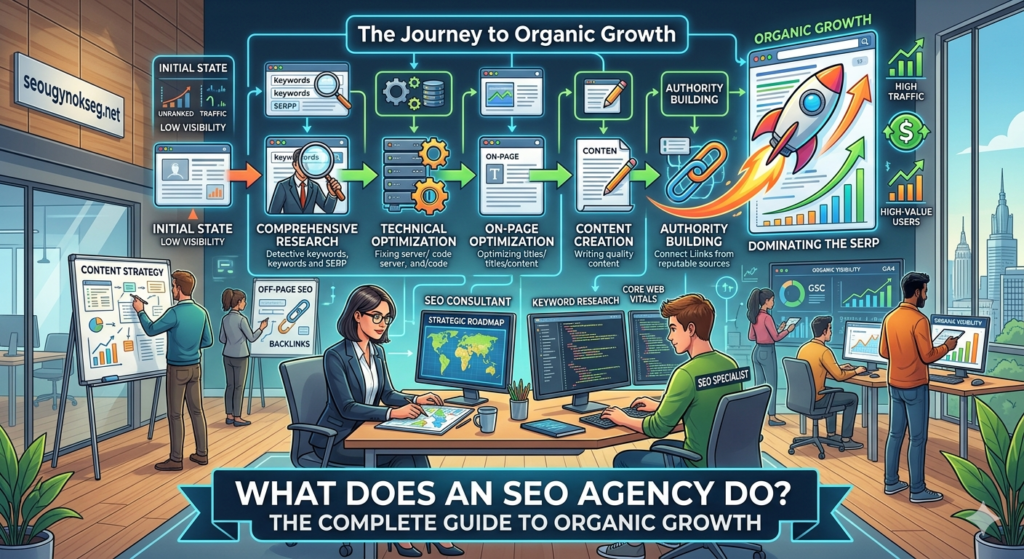
The Journey to Dominating the SERP
Achieving organic growth is not a one-time event; it is a continuous, iterative process. When you partner with a top-tier SEO firm, they will guide your website through a proven methodology designed to dominate the SERP (Search Engine Results Page). Here is what that journey looks like.
Phase 1: Comprehensive Discovery and Research
Before any changes are made to your website, the agency must understand where you currently stand. This begins with a deep-dive technical audit to uncover any underlying issues preventing search engines from crawling and indexing your site.
Simultaneously, the team will research your target audience’s search behavior. This goes far beyond finding high-volume keywords; it involves understanding search intent. Are users looking for information, comparing products, or ready to buy? By mapping these intents, the agency ensures that the right pages are positioned for the right queries.
Phase 2: Technical and On-Page Optimization
With the roadmap in place, the agency begins to optimize the website. This starts with the technical foundation:
- Site Speed & Core Web Vitals: Ensuring the site loads instantaneously and provides a seamless user experience.
- Mobile Optimization: Guaranteeing flawless performance on smartphones, a critical factor for modern search engines.
- Site Architecture: Restructuring navigation so that both users and search engine crawlers can easily find your most important pages.
Next, the focus shifts to on-page optimization. The agency will refine meta titles, descriptions, and header tags. They will audit your existing content, expanding thin pages and ensuring that your copy demonstrates Experience, Expertise, Authoritativeness, and Trustworthiness (E-E-A-T)—the gold standard for ranking on Google Search.
Phase 3: Content Strategy and Creation
You cannot rank for queries if you do not have content that answers the user’s questions. Based on their research, the agency will help you develop a robust content strategy. This might involve creating dedicated service pages, comprehensive “how-to” guides, or industry-specific whitepapers. The goal is to establish your website as the ultimate topical authority in your niche.
Phase 4: Off-Page SEO and Authority Building
Google and other search engines view links from other reputable websites as “votes of confidence.” An SEO agency will execute strategic outreach campaigns, digital PR, and relationship-building to earn high-quality backlinks to your site. This off-page optimization is often the deciding factor in highly competitive industries. The more authoritative websites that link to you, the more search engines will trust your domain, pushing you higher up the SERP.
Phase 5: Measurement, Analytics, and Refinement
SEO is a dynamic field. Algorithms update, competitors adjust their strategies, and consumer behavior evolves. A great agency is relentlessly analytical. They will monitor your rankings, track organic conversion rates, and provide transparent reporting. By continuously analyzing the data, they can pivot strategies, doubling down on what works and adapting to new search trends to protect and grow your digital market share.
Why Organic Growth is the Ultimate Business Asset
For founders focused on long-term enterprise value, organic search is unmatched. While paid acquisition costs continue to rise across almost all platforms, the cost of organic traffic effectively decreases over time. A piece of highly optimized content or a strong backlink profile can continue to drive targeted, high-converting traffic for years after the initial investment was made.
By partnering with a dedicated search engine optimization agency, you are not just buying traffic; you are building a digital asset that compounds in value, creating a sustainable moat around your business that competitors cannot easily buy their way through.
Frequently Asked Questions
How do I choose the right SEO agency?
Choosing the right partner requires careful vetting. Look for an agency that is highly transparent about their methodologies—if they promise guaranteed overnight rankings or refuse to explain their link-building tactics, walk away. Ask for case studies that demonstrate sustained growth over time, not just sudden spikes. A good agency will ask you detailed questions about your business model, customer lifetime value, and profit margins, proving that they are focused on revenue, not just vanity metrics. Finally, ensure you have direct access to an SEO consultant who can clearly explain the strategy to your executive team.
How long does SEO take to show results?
Unlike paid advertising, SEO is a long-term strategy that requires patience. Generally, you should expect to see noticeable improvements in rankings and organic traffic within 3 to 6 months. However, highly competitive industries may take 9 to 12 months to see a significant return on investment. The timeline depends heavily on the current state of your website, the age of your domain, the aggressiveness of your competition, and the resources allocated to the campaign. Remember, SEO is about building sustainable, compounding growth; the results achieved in month 12 will far outpace the results seen in month 3.