Introduction: Understanding the Scope of Plastic Surgery
When the term plastic surgery is mentioned, popular culture often conjures images of elective enhancements and celebrity makeovers. However, this vast and complex medical specialty extends far beyond superficial changes. At its core, plastic surgery is a dedicated medical field focused on altering, repairing, and restoring the human body. It encompasses two primary, often overlapping branches: aesthetic surgery (often referred to as cosmetic surgery) and reconstructive surgery.
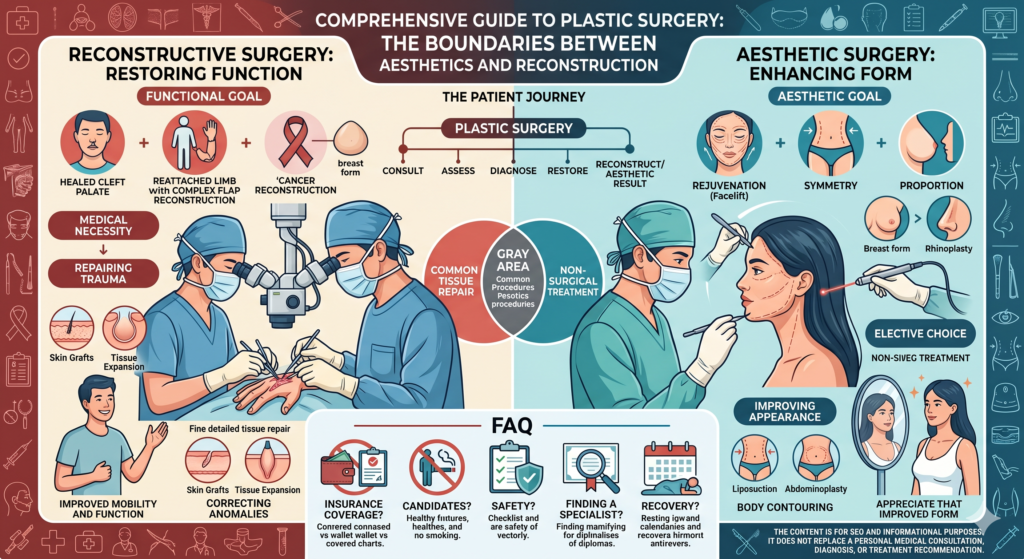
For a patient navigating healthcare options, understanding the distinction between these two branches is crucial. While both utilize similar surgical techniques and require a highly trained specialist, their foundational purposes differ significantly. Aesthetic procedures are primarily driven by an aesthetic goal—enhancing symmetry, proportion, and youthfulness. Conversely, reconstructive procedures are driven by a functional goal—repairing damage, restoring mobility, and returning the body to a normal state following trauma, congenital anomalies, or disease.
This comprehensive guide is designed to clarify these concepts, detail the boundaries between aesthetics and reconstruction, and provide patients with the objective, evidence-based information necessary to make informed healthcare decisions.
What is Plastic Surgery?
To answer the fundamental question—What is plastic surgery?—we must look at its origins and clinical definition. Derived from the Greek word plastikos, which means “to mold” or “to give form,” plastic surgery is a specialized surgical discipline that involves the restoration, reconstruction, or alteration of the human body.
A board-certified plastic surgeon is a highly trained specialist who must deeply understand tissue behavior, blood supply, wound healing, and human anatomy. These surgeons undergo years of rigorous medical training to ensure they can safely manipulate skin, muscle, and bone. Whether a patient requires a cosmetic procedure to boost self-esteem or a complex microsurgical operation to reattach a severed limb, the underlying surgical principles remain identical. The differentiation lies entirely in the underlying intent and medical necessity of the operation.
Aesthetic Surgery: Enhancing Form and Symmetry
Aesthetic surgery focuses entirely on enhancing the physical appearance of an individual. These are elective procedures performed on normal, healthy body parts. The primary objective is to improve aesthetic appeal, symmetry, and proportion, often leading to enhanced psychological well-being and self-confidence.
The Goals of Aesthetic Procedures
Because aesthetic surgery treats areas of the body that function properly, the procedures are rarely medically necessary. The focus is placed on:
- Rejuvenation: Reversing the visible signs of aging (e.g., facelifts, eyelid surgery, neck lifts).
- Enhancement and Proportion: Altering the size or shape of a body part to achieve a balanced look (e.g., breast augmentation, rhinoplasty, lip augmentation).
- Body Contouring: Removing stubborn fat or excess skin, often after significant weight loss or pregnancy (e.g., liposuction, abdominoplasty or “tummy tuck”).
Elective Nature and Patient Perspective
Since a cosmetic procedure is elective, the decision to undergo surgery rests entirely with the patient. A responsible plastic surgeon will rigorously consult with the individual to ensure their expectations are realistic and that they are psychologically prepared for the transformation. It is the physician’s duty to assess the patient’s overall health and confirm that they are undergoing the procedure for themselves, not due to external pressures.
Reconstructive Surgery: Restoring Function and Quality of Life
If aesthetic surgery is about enhancement, reconstructive surgery is about restoration. These procedures are performed on abnormal structures of the body caused by congenital defects, developmental abnormalities, trauma, infection, tumors, or disease. The primary objective is to achieve a functional goal, though achieving a normal appearance is also a critical secondary priority.
Medical Necessity and Indications
Reconstructive surgery is generally considered medically necessary. It aims to improve a patient’s quality of life, alleviate pain, and restore essential bodily functions. Common categories include:
- Trauma and Burn Care: Skin grafting and tissue expansion to restore mobility and function after severe burns or accidents.
- Cancer Reconstruction: Procedures such as breast reconstruction following a mastectomy or flap surgery to rebuild areas of the face and neck after tumor removal.
- Congenital Anomalies: Correcting birth defects such as cleft lip and palate, webbed fingers (syndactyly), or ear deformities (microtia).
- Hand Surgery: Repairing severed tendons, nerves, or addressing conditions like carpal tunnel syndrome to regain fine motor skills.
In these scenarios, the specialist must diagnose the functional deficit accurately and formulate a surgical plan that maximizes the patient’s physical recovery.
What is the Difference Between Aesthetic and Reconstructive Surgery?
To directly answer the common search intent—What is the difference between aesthetic and reconstructive surgery?—we can categorize the distinctions into four main pillars: Purpose, Medical Necessity, Insurance Coverage, and Surgical Focus.
| Feature | Aesthetic Surgery | Reconstructive Surgery |
| Primary Goal | To enhance appearance, symmetry, and proportion. | To restore function and achieve a “normal” appearance. |
| Condition Treated | Normal, healthy anatomy. | Abnormalities (trauma, disease, congenital defects). |
| Medical Necessity | Elective (not medically required). | Medically necessary to improve health or function. |
| Insurance Coverage | Rarely covered by health insurance. | Often covered by health insurance (varies by policy). |
| Typical Procedures | Facelift, liposuction, breast augmentation. | Cleft palate repair, breast reconstruction, skin grafts. |
The Gray Area: Where Aesthetics and Reconstruction Meet
It is important to note that the boundary between these two fields is sometimes blurred. For example, a rhinoplasty (nose job) may be performed purely to change the shape of the nose (an aesthetic goal). However, if the patient also has a deviated septum causing severe breathing issues, the surgeon may perform a septorhinoplasty to fix the breathing (a functional goal) while simultaneously altering the external appearance. In these cases, the surgeon utilizes both reconstructive and aesthetic philosophies simultaneously.
The Patient Journey: The Role of the Specialist
Whether seeking a subtle cosmetic tweak or a major reconstructive overhaul, the patient journey relies entirely on the expertise and ethics of the attending medical professional.
- Consult: The process begins with an in-depth consultation. The surgeon listens to the patient’s concerns, goals, and medical history.
- Assess: The specialist will thoroughly assess the physical anatomy in question, taking measurements and evaluating tissue quality, bone structure, and overall physiological health.
- Diagnose: For reconstructive cases, the physician will diagnose the specific structural or functional deficit. For aesthetic cases, they will identify the anatomical realities that can or cannot be altered safely.
- Restore: Finally, utilizing advanced surgical techniques, the surgeon operates to restore form, function, or aesthetic harmony, guiding the patient through the critical post-operative recovery phase.
Adhering to the guidelines set by major medical bodies, such as the American Society of Plastic Surgeons (ASPS) or the National Health Service (NHS), a certified surgeon prioritizes patient safety, ethical practice, and evidence-based medicine above all else.
Frequently Asked Questions (FAQ)
1. Does insurance cover reconstructive surgery?
Yes, in most cases, reconstructive surgery is covered by health insurance, national health services (like the NHS), or private medical insurance because it is deemed medically necessary to restore function or correct abnormalities caused by disease or trauma. However, coverage specifics vary by provider, so patients must verify their policy details. Aesthetic surgeries, being elective, are generally not covered.
2. Who is a good candidate for a plastic surgery procedure?
A good candidate is an individual who is in generally good physical health, does not smoke (or is willing to quit prior to surgery, as smoking severely impacts healing), and has realistic expectations about the outcomes. Psychological readiness is just as important as physical health, particularly for aesthetic procedures.
3. Is aesthetic surgery completely safe?
No surgery is entirely without risk. While modern medical advancements have made cosmetic procedures exceptionally safe, potential risks include infection, adverse reactions to anesthesia, hematoma, and scarring. Consulting with a board-certified specialist drastically minimizes these risks.
4. How do I choose a qualified plastic surgeon?
Always look for a board-certified plastic surgeon. In the US, look for certification by the American Board of Plastic Surgery (ABPS); in the UK, look for surgeons listed on the GMC specialist register for plastic surgery. Verify their credentials, read patient reviews, and ask to see “before and after” photos of their previous work during your consultation.
5. How long is the recovery time after plastic surgery?
Recovery time varies wildly depending on the procedure. A minimally invasive cosmetic procedure like Botox requires no downtime, whereas a major reconstructive flap surgery or a full abdominoplasty may require weeks of rest and months before the final results are fully visible. Your surgeon will provide a tailored timeline during your consultation.